
Telehealth Therapy in Seattle: Online Counseling That Fits Your Life
Discover how telehealth therapy works, its benefits, privacy considerations, and how to find online counseling in Seattle with Havencrest Wellness & Counseling.
12 min read

Article
You don’t have to know the perfect approach or find a flawless match before you begin. A few practical questions can help you narrow your options and start a conversation with more confidence. Gather information about the therapist’s experience, approach, and communication style, then consider whether they seem suitable for you.
Content Team· 12 min read
What if finding the right therapist isn’t about choosing a perfect approach on day one, but starting a conversation about what you need? Looking for individual counseling Seattle can bring up practical questions: Will I feel comfortable sharing personal experiences? Which kind of therapy might fit? Would in-person sessions or telehealth work better for me? It’s reasonable to want clarity before taking that first step.
Individual counseling gives you space to explore concerns, understand patterns, and work toward goals at a manageable pace. You don’t need to arrive with a diagnosis or a complete plan. A collaborative conversation can help you clarify what you’re looking for and whether an approach such as CBT, DBT, or EMDR is worth discussing.
This guide explains what individual counseling involves, how to compare approaches and therapist fit, and what to consider before getting started. You’ll also find questions to ask about Seattle appointments, telehealth across Washington, scheduling, fees, and insurance coverage.
Individual counseling can help you explore concerns and goals, even if you don’t have a diagnosis or a clear plan yet.
CBT, DBT, and EMDR have different focuses. Ask a therapist how an approach might relate to your needs and preferences.
Compare clinician information, relevant experience, practical details, and whether you feel heard during your conversation.
For individual counseling Seattle, you can prepare questions for the first session, but you don’t need a script or fully formed goals.
Havencrest offers individual therapy and approaches including CBT, DBT, and EMDR for you to discuss with a clinician.
Individual counseling is one-to-one work with a therapist, shaped around your concerns, needs, and goals. You don’t need a diagnosis or a complete explanation of what’s troubling you to begin. You might want help understanding what has been weighing on you, or a thoughtful space to reflect and consider what you’d like to change.
Individual counseling focuses on one person’s experiences and goals, rather than a couple’s relationship or a family’s shared dynamics. In individual counseling Seattle, the conversation centers on your perspective. You and your therapist can decide what feels useful to explore.
The broader practice of Psychotherapy includes different ways of supporting mental well-being. In individual sessions, what you discuss and how you approach it can depend on your circumstances, preferences, and the therapist’s experience.
People seek support for many reasons, and those reasons don’t have to fit a label. Sessions might offer room to discuss:
Stress, feeling overwhelmed, or changes in emotional well-being.
Life transitions, such as changes in work, health, identity, or daily responsibilities.
Relationship patterns, communication challenges, or recurring conflict.
Personal questions, difficult experiences, or hopes for what comes next.
You can start with one concern and discover that other topics matter too. There’s no single pace or guaranteed outcome; progress looks different from person to person. If you’re worried about immediate safety or might harm yourself or someone else, contact local emergency services or a crisis support service in your area.
Therapy is a conversation you help shape. You and your therapist can clarify what you hope to get from sessions, then revisit those goals as your needs change. You can ask why a topic or exercise is being suggested, share what feels helpful, and say when something doesn’t seem to fit.
Your preferences and boundaries matter. You might want to take a topic slowly, understand how sessions are structured, or talk about cultural or personal experiences that affect what feels comfortable. Questions and honest feedback help you assess whether the work feels useful. A good fit doesn’t mean every conversation is easy. It means you can help shape the work and speak up about what you need.
Therapy approaches offer different ways to structure conversations and explore concerns. Cognitive behavioral therapy (CBT), dialectical behavior therapy (DBT), and eye movement desensitization and reprocessing (EMDR) aren’t competing promises, and no approach guarantees a particular result. A useful approach should make sense for your needs, while your relationship and sense of fit with the therapist matter too.
In individual counseling Seattle, ask a clinician to explain how they work and why a particular approach might be relevant. Start with your goals, rather than feeling pressured to choose a label before you understand it.
CBT broadly explores how thoughts, feelings, and behaviors can connect, and how noticing those patterns may inform new ways of responding. DBT broadly emphasizes skills related to emotional regulation and coping. For an overview, see Dialectical Behavioral Therapy (DBT) from Columbia University’s Department of Psychiatry. These brief descriptions are starting points, not a way to decide on your own which approach is appropriate.
EMDR is another approach a therapist may discuss. Havencrest offers EMDR, but whether it’s relevant depends on your concerns and the clinician’s assessment. You can ask about the clinician’s experience, how sessions may relate to your goals, what readiness involves, and what questions or reservations you have. A dedicated EMDR therapy in Seattle guide can provide more detail when available.
Quick comparison
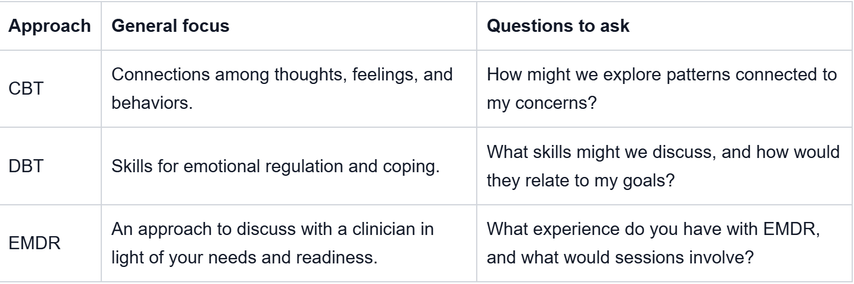
These approaches are options to discuss, not fixed tracks. Your clinician can explain their perspective, answer questions, and consider your preferences with you. If your needs change, you can ask whether an approach should be adjusted. What’s suitable is something to discuss together.
If you’re considering individual therapy, learn about Havencrest’s counseling services and ask a clinician how CBT, DBT, or EMDR might relate to the concerns you want to explore.
You don’t have to know the perfect approach or find a flawless match before you begin. A few practical questions can help you narrow your options and start a conversation with more confidence. Gather information about the therapist’s experience, approach, and communication style, then consider whether they seem suitable for you.
Clarify what you hope to explore. You might want support with stress, a life transition, relationship patterns, or another concern. A broad starting point is enough; your goals can become clearer over time.
Review clinician information. Look at stated training, areas of experience, and therapeutic approaches. Verify a clinician’s current Washington credential through a reliable state licensing source, and ask about experience related to the topics you want to discuss.
Compare practical details. Consider whether you prefer in-person appointments in Seattle or telehealth sessions, along with location, scheduling options, fees, insurance participation, and communication preferences. Confirm current details directly with the practice.
Ask questions before deciding. Ask how sessions are structured, how goals are set, and how the therapist responds to feedback. You can also ask about boundaries and how to communicate between sessions.
Notice your experience of the conversation. Do you feel listened to and able to ask questions? You don’t have to decide that the first therapist or approach must be the perfect match. Fit can become clearer as you learn more and discuss what is or isn’t working.
Online profiles can help you identify possibilities, but they can’t tell you exactly what working together will feel like or establish clinical quality on their own. Use them to prepare questions, then ask directly about fit. Explore counseling with Havencrest and ask about clinician fit, availability, fees, and insurance.
Try asking, “What experience do you have with concerns like mine?” or “How would you describe your approach?” You might also ask what a typical session involves and how you’ll decide together whether the work feels useful. If you have preferences about pace, language, or topics you’re not ready to discuss, you can raise them. A respectful conversation should leave room for your questions and boundaries.
Consider the whole experience, not only a list of specialties. Does the appointment format work for your life? Are the location and scheduling manageable? Can you communicate in a way that feels comfortable? For individual counseling Seattle, these practical details matter alongside whether the clinician’s stated experience and approach align with your goals. Confirm specifics with the practice, since profiles may not reflect current availability or answer every question about care.
Starting therapy can feel more manageable when you know the first appointment is a chance to talk, ask questions, and see what feels comfortable. You don’t need to prepare a polished account of your life or decide on every goal beforehand. If you’re considering individual counseling Seattle, a few notes or questions may help, but preparation is optional.
An initial session may include a conversation about what brought you to counseling, what you hope support might offer, and any personal history you feel is relevant. The clinician may ask about your preferences and begin exploring possible goals with you. You can share at your own pace and say if you’re not ready to discuss a particular topic.
The clinician may also describe their approach, explain confidentiality and its limits, and talk through possible next steps. The exact structure varies by clinician and by what you need. These are general possibilities, not a promise about any practice’s intake process, so ask Havencrest directly what to expect when booking.
Before booking, consider asking about the clinician’s experience, session format, scheduling, fees, insurance, confidentiality, and what the first appointment may involve.
Havencrest offers in-person appointments in Seattle and telehealth sessions across Washington. Consider which format may be practical and comfortable for you. In-person sessions involve traveling to an appointment location. Telehealth may make it easier to meet from a private space, if the service is appropriate for your circumstances.
Before scheduling, confirm the current appointment location, available times, telehealth technology requirements, privacy considerations, and eligibility details with the practice. For an online session, check your internet connection and choose a place where you can speak comfortably and privately. You can also ask what to do if technical difficulties interrupt an appointment.
A Washington telehealth therapy guide can offer more detail when available. In the meantime, these questions can help you compare formats without assuming one is right for everyone.
Your first session is also a chance to notice how the conversation feels. You can ask for clarification, share what you’d prefer to focus on, and discuss next steps together. There’s no need to have everything figured out before you begin.
To ask about starting individual therapy and what to expect, contact Havencrest about counseling.
Havencrest Wellness & Counseling is a Seattle-based practice offering individual therapy, with in-person appointments in Seattle and secure telehealth sessions across Washington. If you’re considering individual counseling Seattle, these formats and approaches give you a place to start a conversation. You don’t need to know exactly what you need before reaching out.
Havencrest offers CBT, DBT, and EMDR among its therapeutic approaches. Each has a different focus, and no single approach is right for everyone. Describe what you’d like support with and ask a clinician whether an approach might be relevant to your needs. Your questions and preferences can be part of that discussion.
It’s reasonable to want practical details before deciding what to do next. You might ask:
Which clinicians are currently available, and what experience do they have with the concerns you hope to discuss?
Are in-person appointments or telehealth sessions available for your situation, and what locations or eligibility details should you confirm?
What are the current fees, insurance participation, and billing practices?
Can you share access needs, communication preferences, or other considerations that may affect your comfort?
Confirm these details directly with the practice, since clinician availability, appointment locations, and coverage information can change. Asking about insurance doesn’t assume a particular plan is accepted; it helps you understand what to verify for your circumstances.
Keep it simple: identify one question, contact the practice, and use the conversation to explore whether the available care may fit. For example, ask about telehealth eligibility first, or share that you’re interested in discussing CBT, DBT, or EMDR with a clinician. You don’t need a complete therapy plan ready.
An inquiry is a way to gather information, not a commitment to continue long term. Take time to consider what you learn, ask follow-up questions, and decide what feels right for you. The next step can be small.
Contact Havencrest to ask about individual counseling, including current clinician availability, experience, formats, fees, and insurance details.
Choosing a therapy approach isn’t about finding a guaranteed solution. It’s about exploring what may suit your concerns and working with a therapist who listens, explains their approach, and welcomes your questions. Your goals can take shape over time, and it’s okay to ask for clarification or share what feels comfortable.
If you’re considering individual counseling Seattle, practical fit matters too. Havencrest Wellness & Counseling is a Seattle-based practice offering in-person appointments and telehealth across Washington. Individual therapy approaches include CBT, DBT, and EMDR, which you can discuss with a clinician in light of your needs. Before deciding, confirm current availability, appointment details, fees, and insurance information directly with the practice.
You don’t have to know exactly what to say or commit to a long-term plan just to ask a question. A simple inquiry can help you learn what options may fit and consider your next step at your own pace.
Reach out to Havencrest to explore individual counseling. Starting with a conversation is enough; you can move forward one step at a time.
Our team will help you find the clinician and service that fit what you are looking for.
Request appointmentDiscover how telehealth therapy works, its benefits, privacy considerations, and how to find online counseling in Seattle with Havencrest Wellness & Counseling.
CBT ranks best overall for life transitions in 2026, with family, trauma-focused, and short-term options for specific situations. Compare all six approaches.
Therapy in Washington costs $100-250 self-pay or $20-50 with insurance in 2026. See the full cost breakdown by payment type and provider before you book.